Five charts explain Wall Street banks’ fourth-quarter earnings, capturing a year-end performance that left the industry confident heading into 2026, even as political and economic uncertainties linger.
Wall Street’s biggest banks wrapped up 2025 with solid fourth-quarter results, striking an optimistic tone about the months ahead. Executives pointed to resilient consumer activity, healthy capital markets, and strong trading desks as key drivers of momentum. Still, the sector remains watchful after U.S. President Donald Trump floated a proposal to cap credit card interest rates, a move that has unsettled bank leaders and investors alike.
Analysts believe the pipeline of high-profile initial public offerings and large corporate deals will continue to support investment banking revenues. At the same time, ongoing market volatility is expected to keep trading businesses active and profitable.
Consumer Banking in Focus
Consumer and commercial banking delivered steady gains in the quarter. Net interest income — a core measure of lending profitability — increased across major banks, supported by solid loan growth and easing pressure from deposit costs. Demand for commercial and industrial loans held up, while credit card balances also edged higher despite the persistence of elevated interest rates.
The industry, however, is closely watching Washington. Trump’s proposed 10% cap on credit card interest rates sparked sharp criticism from bank executives, who warned that such a limit could curb credit access for everyday consumers and ultimately slow economic growth. Credit cards remain among banks’ most lucrative products, reflecting their unsecured nature and higher interest rates.
Credit Quality Under the Microscope
Credit performance remains a central concern for analysts and shareholders assessing the health of households and businesses. Investors paid close attention to charge-offs — loans banks deem unlikely to be repaid — as a signal of financial stress.
So far, results suggest consumers are largely holding up, supported by continued employment and stable spending patterns. Even so, banks are maintaining a cautious stance as they monitor potential cracks in household finances.
Investment Banking Rebounds
Investment banking emerged as a clear bright spot. Global mergers and acquisitions activity rebounded strongly in 2025, pushing worldwide investment banking revenues above $100 billion, according to Dealogic data.
Bankers are increasingly confident about another strong year ahead. Easing antitrust pressures, equity markets near record highs, and a resilient U.S. economy have improved sentiment around dealmaking and capital raising.
Trading Desks Ride Volatility
Market turbulence worked in banks’ favor, fueling revenue from client portfolio rebalancing and proprietary trading. Demand surged for products designed to hedge against sharp market swings, further boosting performance.
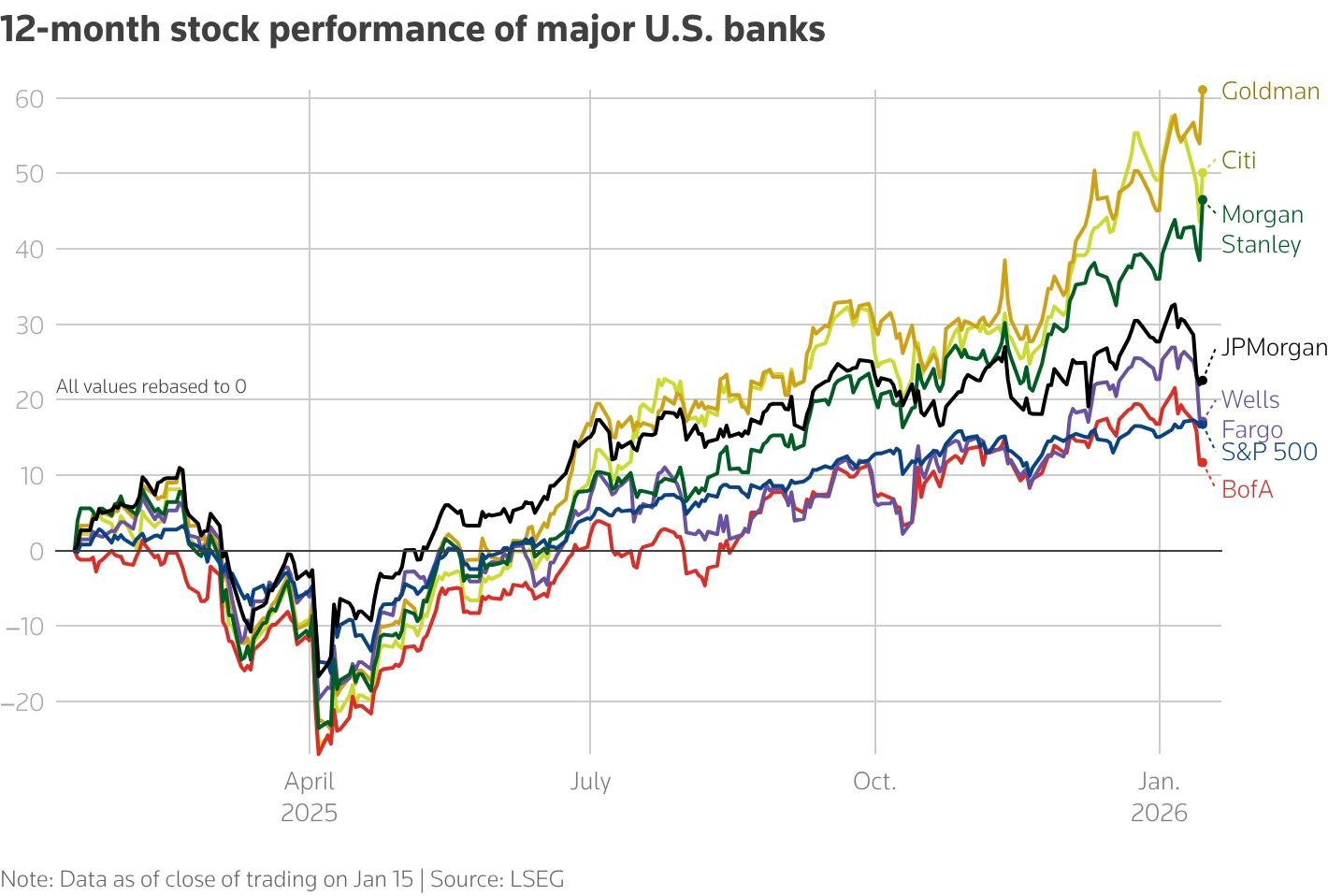
“Equity trading revenues have been the story of the earnings so far,” said Brian Mulberry, senior client portfolio manager at Zacks Investment Management. He noted that increased use of leverage and options played a major role in driving growth.
Volatility is widely expected to persist into 2026, driven by concerns over stretched valuations, a potential bubble in AI-related stocks, and uncertainty surrounding the Federal Reserve’s future policy path.
Outlook for 2026
Despite lingering risks, the overall mood across Wall Street remains constructive. “We are bullish on the big banks,” Mulberry said, pointing to a stable economy, a labor market that has softened but not collapsed, and consumers who continue to spend amid relatively stable prices.
Taken together, the fourth-quarter results suggest that while challenges lie ahead, Wall Street’s largest banks enter the new year on firm footing — a story clearly illustrated in Five charts explain Wall Street banks’ fourth-quarter earnings.