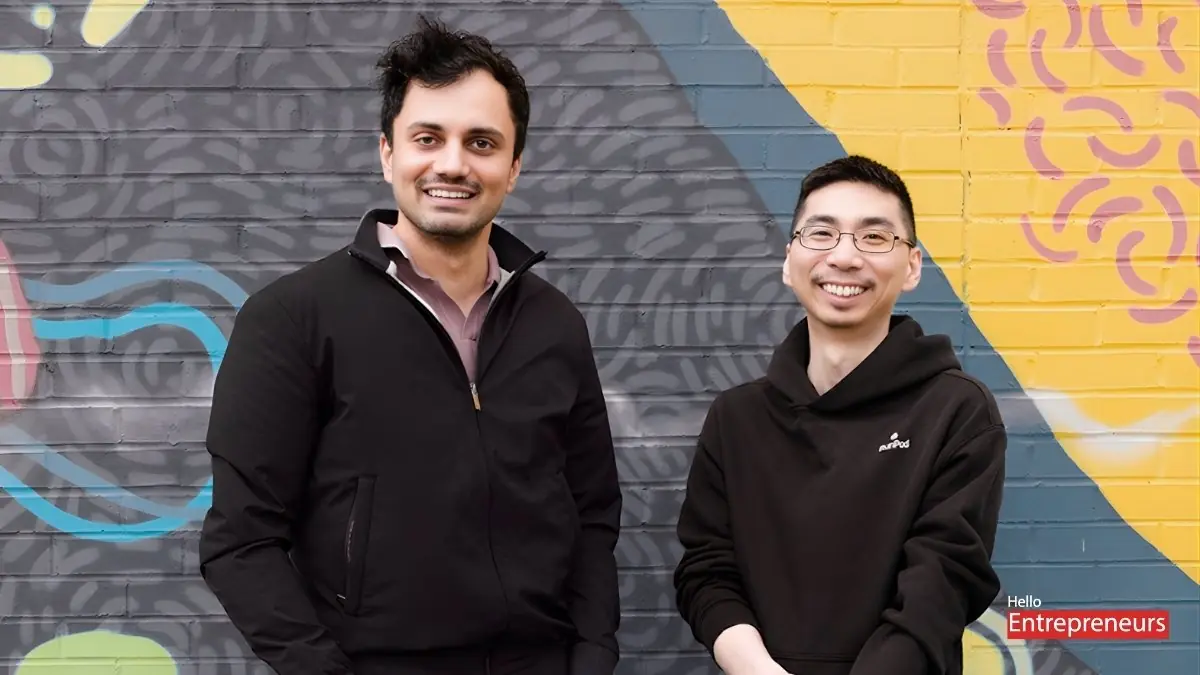
AI cloud startup Runpod reaches $120M in ARR after launching from a single Reddit post—a headline that perfectly captures one of the most unconventional startup success stories in the AI space today.
Runpod, an AI application hosting platform founded four years ago, has crossed an impressive $120 million annual recurring revenue milestone. Founders Zhen Lu and Pardeep Singh shared with TechCrunch that their journey proves one simple truth: when strong execution meets the right timing, unexpected things can happen.
What makes their story remarkable isn’t just the revenue number—it’s how organically everything unfolded, from bootstrapping in basements to attracting top-tier investors without traditional marketing.
The Accidental Beginning: When Crypto Mining Got Boring
The story starts in late 2021, when Lu and Singh were working as corporate developers at Comcast. Outside of work, they shared a hobby: building Ethereum mining rigs in their New Jersey basements. Together, they spent roughly $50,000 on GPUs and hardware.
While they managed to mine some crypto, it was clear the returns wouldn’t justify the investment. Ethereum’s upcoming network upgrade, known as “The Merge,” would soon make their setup obsolete. Worse, the whole process quickly became dull.
But there was a problem they couldn’t ignore—those expensive GPUs still needed a purpose, especially after convincing their spouses the investment was worthwhile.
Discovering a Pain Point in AI Infrastructure
Both founders were already working on machine learning projects professionally, so they decided to repurpose their mining rigs into AI servers. This was before ChatGPT, and even before DALL·E 2 had entered the mainstream.
As they rebuilt their systems, they ran into a frustrating reality: the software stack for using GPUs was painfully inefficient. For experienced developers like Lu and Singh, it felt unnecessarily complicated and poorly designed.
That frustration sparked an idea.
Runpod was born out of a simple belief: developing AI software on GPUs didn’t have to feel like “hot garbage,” as Lu bluntly described it.
Launching Runpod with a Reddit Post
By early 2022, they had built a working platform. Runpod focused on fast AI app hosting, flexible hardware configuration (including serverless GPU options), and developer-friendly tools such as APIs, command-line interfaces, and integrations like Jupyter notebooks.
The next challenge was marketing—and as first-time founders, they had no clue where to start.
So they chose the simplest option available.
Lu posted about Runpod in a few AI-focused subreddits, offering free access to their GPU servers in exchange for feedback. The response was immediate. Beta users signed up, feedback poured in, and soon those users converted into paying customers.
Within nine months, Lu and Singh quit their jobs and hit $1 million in revenue—without spending a dollar on ads.
Bootstrapping Through Growing Pains
Rapid growth introduced new challenges. Business customers wanted reliable, enterprise-grade infrastructure—not servers running out of residential basements.
Instead of raising venture capital right away, the founders chose to stay independent. They partnered with data centers through revenue-sharing agreements to expand GPU capacity. The approach worked, but it came with constant pressure.
If GPU availability lagged, users would leave. In the AI world, capacity equals trust.
Despite the stress, Runpod never offered a free tier. The business had to sustain itself from day one. Unlike other AI cloud platforms that evolved from crypto mining and took on heavy debt, Runpod stayed disciplined and revenue-driven.
Investors Come Knocking—Organically
As Runpod’s developer community grew on Reddit and Discord—especially after ChatGPT’s launch—investors started paying attention.
Radhika Malik, a partner at Dell Technologies Capital, discovered Runpod through Reddit posts and reached out. It was Lu’s first-ever VC conversation, and he didn’t even know how to pitch. Malik walked him through how investors think and stayed in touch as the company continued to grow.
Another pivotal moment came when Hugging Face co-founder Julien Chaumond reached out—not as an investor, but as a user. He had been using Runpod and contacted the team through customer support chat. That conversation eventually turned into angel investment and long-term backing.
Hitting Scale: $120M ARR and Half a Million Developers
By May 2024, the AI boom was in full swing, and Runpod’s early decision to focus on AI developers paid off massively. The platform reached 100,000 developers and closed a $20 million seed round co-led by Dell and Intel’s venture arms, with participation from figures like Nat Friedman and Chaumond.
Today, the numbers are even more striking:
-
500,000 developers using the platform
-
Customers ranging from solo builders to Fortune 500 companies
-
31 global cloud regions
-
Clients including OpenAI, Replit, Cursor, Perplexity, Wix, and Zillow
And yes—AI cloud startup Runpod reaches $120M in ARR after launching from a single Reddit post, a feat few startups can claim.
Competing with Giants—By Staying Developer-First
Runpod operates in a fiercely competitive landscape. Developers can choose hyperscalers like AWS, Microsoft Azure, and Google Cloud, or specialized GPU providers like CoreWeave and Core Scientific.
But Runpod doesn’t try to outmuscle the giants. Instead, it positions itself as a developer-centric platform built by developers, for developers.
Lu believes coding isn’t disappearing—it’s evolving. Developers are becoming AI agent builders and operators, and Runpod wants to be the platform they grow up using.
Looking Ahead
Runpod hasn’t raised additional funding since its seed round, but the founders are preparing for a future Series A, backed by strong fundamentals and real revenue.
Their story is a reminder that sometimes, the most impactful companies don’t start with pitch decks or accelerators—just a real problem, a smart solution, and one well-timed Reddit post.