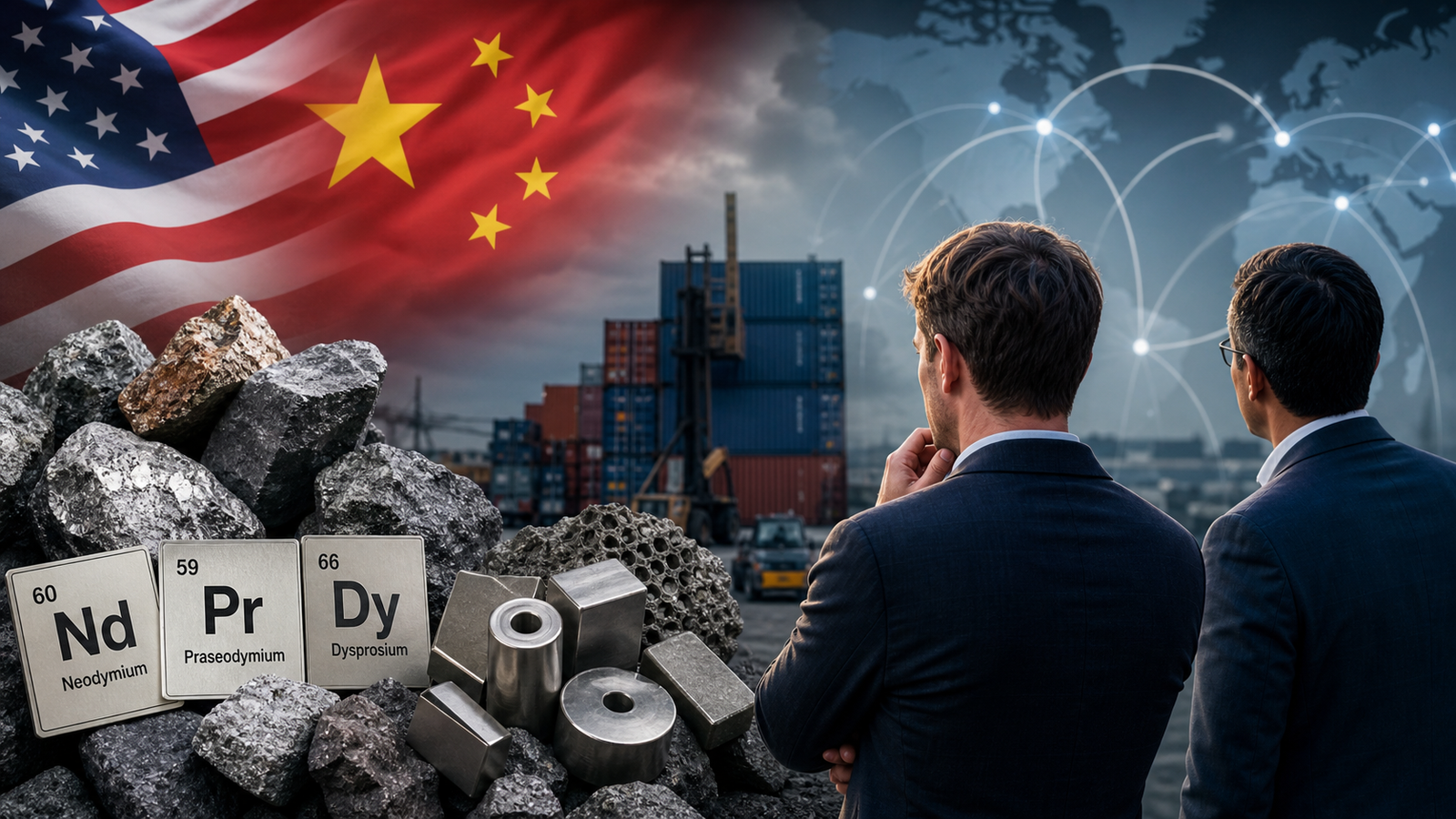
Hardware Founders Watch Trade Talks as Rare Earth Controls Put US Supply Chains Under Pressure
Hardware Founders Watch Trade Talks closely as US President Donald Trump and Chinese President Xi Jinping meet in Washington, with rare-earth minerals emerging as one of the most important issues for technology and automotive supply chains.
For US hardware and electric vehicle startups, the negotiations are more than a geopolitical discussion. Rare earths are essential inputs for permanent magnets and other components used in automobiles, computers, industrial equipment and a wide range of advanced technologies.
The outcome of the Trump-Xi meeting could therefore influence how startups plan sourcing, manufacturing and inventory for products that depend on Chinese materials or components.
Why Rare Earths Matter to Hardware Startups
Rare earth elements are used in technologies that require powerful and compact magnets. These include electric motors, consumer electronics, industrial machinery and various advanced technology systems.
China has a particularly important position in the global supply chain because of its mining, processing and magnet-manufacturing capabilities.
Reuters reported on September 24 that the United States is expected to remain dependent on China for rare earths well into the 2030s, even as American companies expand domestic mining and processing. Current US production of two commonly used rare earths meets only about 42% of domestic demand, according to data cited by Reuters from Benchmark Mineral Intelligence.
That dependence creates a significant consideration for startups building physical products in the United States.
China’s Export Controls Remain a Major Concern
China has maintained export licensing requirements covering several medium and heavy rare earths, including samarium, gadolinium, terbium, dysprosium, lutetium, scandium and yttrium.
Some of these materials are particularly important for high-performance magnets used in electric motors and other industrial applications.
The issue is not simply whether material exists. Companies also need reliable access to processed materials, magnets and components that meet their technical specifications.
For young hardware companies, interruptions or delays can be difficult to absorb because they often operate with smaller inventories and fewer alternative suppliers than established manufacturers.
US Hardware and EV Startups Face Supply Chain Questions
Electric vehicle companies are among the businesses with exposure to rare-earth supply constraints because electric motors can use permanent magnets containing rare earth materials.
The broader hardware sector also faces exposure. Products ranging from industrial machines to advanced electronics can depend on rare-earth materials at different stages of their manufacturing processes.
This means founders are watching the negotiations for indications about whether export licensing will become more predictable or whether restrictions could tighten.
Reuters reported earlier in September that some Chinese rare-earth suppliers had declined to ship to US customers because of concerns about repercussions from Beijing. US officials have also been pressing China to maintain commitments related to the flow of rare-earth export licenses.
Rare Earth Shipments to the US Have Fallen
Recent trade data have added to concerns among companies dependent on Chinese supply.
Chinese exports of rare-earth magnets to the United States fell to 512 metric tons in August, according to Chinese customs data reported by the Financial Times. That represented a 20% decline from July and a 13% decline from August 2025.
The decline comes as the two countries negotiate broader trade arrangements and discuss the future of critical-mineral supplies.
For startups, reduced shipments can translate into longer lead times, higher procurement costs or the need to identify alternative suppliers.
Trump-Xi Summit Puts Critical Minerals on the Agenda
Rare earths are among several major issues being discussed during the Trump-Xi summit.
The September 24 meeting follows negotiations involving tariffs, technology, artificial intelligence and critical minerals. US Treasury Secretary Scott Bessent had also discussed rare earths and other economic issues with Chinese Vice Premier He Lifeng ahead of the leaders’ meeting.
Reuters reported that Washington is seeking more consistent Chinese exports of rare earths and strategic minerals, making supply reliability a central issue in the talks.
For hardware founders, any agreement that improves predictability could affect procurement decisions, while continued uncertainty could encourage companies to accelerate diversification.
Startups Look Beyond China
The supply-chain pressure is also encouraging efforts to develop alternative sources.
The United States has been expanding domestic rare-earth mining and processing capacity, although building a complete alternative supply chain takes time.
Reuters reported that US rare-earth production has increased substantially, but domestic output still does not satisfy total demand. The country is therefore expected to remain reliant on imports for a significant portion of its requirements even as new projects develop.
For startups, diversification can involve sourcing materials from multiple countries, working with alternative magnet manufacturers or redesigning products to reduce dependence on specific materials.
Why Supply Chain Planning Is Becoming a Startup Priority
Hardware startups traditionally face challenges that software companies can avoid, including manufacturing costs, inventory management, logistics and component availability.
Geopolitical trade restrictions add another layer of complexity.
A startup developing an electric motor, robotics system or advanced consumer device may need to consider not only the price and quality of a component but also its country of origin, export-license requirements and the reliability of future shipments.
This can influence decisions made much earlier in the product-development process.
Rare Earths Could Affect EV Innovation
The electric vehicle sector is particularly sensitive to material availability because motor technology is closely connected to magnet performance and efficiency.
If access to particular rare earth materials becomes less predictable, EV manufacturers and their suppliers could explore alternative motor designs, different magnet chemistries or new sourcing arrangements.
Large manufacturers generally have greater purchasing power and more established supplier networks. Startups, however, may need to make these decisions while still developing their manufacturing capabilities.
That makes trade policy an increasingly relevant factor in the development of physical technology companies.
The Bigger Issue: Building Resilient Hardware Supply Chains
The Trump-Xi negotiations highlight a broader challenge facing US hardware founders: building supply chains that can withstand geopolitical disruptions.
China remains deeply integrated into global manufacturing, while US policymakers and companies are pursuing greater domestic production and supply diversification.
The transition will not happen immediately.
For founders, the practical response may involve maintaining multiple suppliers, increasing visibility into lower-tier suppliers and evaluating alternative materials or designs before disruptions occur.
What Hardware Founders Are Watching
As the Trump-Xi talks progress, hardware and EV startups are likely to focus on several developments:
- Whether China provides greater clarity around rare-earth export licenses
- Whether existing trade arrangements affecting critical minerals are extended
- Whether additional export restrictions are introduced
- How quickly US rare-earth mining and processing capacity can expand
- Whether alternative international suppliers can scale
- How rare-earth availability affects magnet and component prices
- Whether EV and hardware manufacturers adjust product designs to reduce material dependence
The implications extend well beyond the companies directly importing rare-earth materials.
A Critical Moment for US Hardware
The rare-earth issue demonstrates how closely technology startups are connected to international trade policy.
For software businesses, geopolitical supply disruptions may have a relatively limited direct effect. For companies building vehicles, robots, electronics and industrial equipment, access to physical materials can determine production capacity and delivery schedules.
As Trump and Xi negotiate over trade and critical minerals, Hardware Founders Watch Trade Talks not simply for changes in tariffs but for signals about the future reliability of the materials their businesses depend on.
The broader challenge for US hardware companies will be developing supply chains that can support rapid growth while reducing exposure to a single source of strategically important materials.
Frequently Asked Questions
1. Why are hardware founders watching the Trump-Xi summit?
Hardware founders are monitoring the talks because rare-earth export controls and trade policies can affect the availability and cost of materials used in technology and manufacturing.
2. Why are rare earths important to EV companies?
Rare earths are used in powerful permanent magnets that can be incorporated into electric vehicle motors and other advanced automotive components.
3. Does the US depend on China for rare earths?
Yes. Although US production and processing capacity are expanding, the United States continues to rely significantly on imported rare earths and related materials.
4. What are China’s rare-earth export controls?
China requires export licenses for certain rare-earth materials and related products, including materials involving several medium and heavy rare earth elements.
5. Have rare-earth shipments from China to the US fallen?
Yes. Chinese rare-earth magnet exports to the US fell to 512 metric tons in August 2026, according to customs data reported by the Financial Times.
6. How could rare-earth restrictions affect hardware startups?
Restrictions can contribute to longer lead times, higher material costs, sourcing difficulties and the need to qualify alternative suppliers or components.
7. What are US companies doing to reduce supply-chain dependence?
The US is expanding domestic rare-earth mining and processing while companies are exploring alternative suppliers and supply-chain diversification.
8. Are rare earths the only issue in the Trump-Xi talks?
No. The broader discussions include tariffs, trade, artificial intelligence, technology and other economic and strategic issues.
9. Why are rare earths strategically important?
Rare earth materials are important inputs for magnets and technologies used across automobiles, electronics, industrial equipment and other advanced manufacturing sectors.
10. What could happen to US hardware supply chains next?
The direction will depend partly on the outcome of US-China negotiations and the implementation of any agreements. Companies are also likely to continue evaluating alternative suppliers, domestic production and product designs that reduce dependence on vulnerable materials.