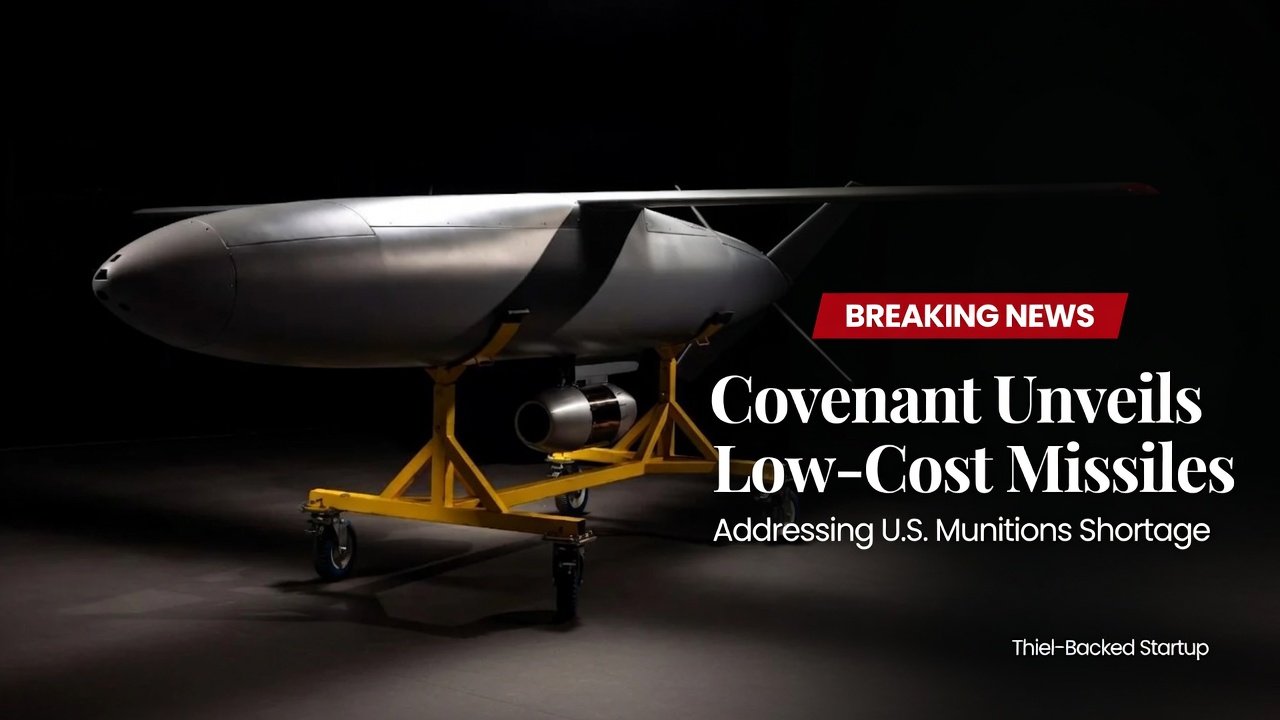
Thiel-Backed Startup Covenant Unveils Low-Cost Missiles Amid U.S. Munitions Shortage
A defense technology startup backed by billionaire investor Peter Thiel is moving into the spotlight with plans to manufacture low-cost, long-range missiles at scale, targeting a major challenge facing the United States and its allies: the need to rebuild missile stockpiles while preparing for the possibility of prolonged conflicts.
The startup, Covenant, has emerged from stealth mode and unveiled Anthem, a heavy-payload, long-range cruise missile designed to be manufactured in large quantities at a lower cost than many traditional systems.
The company has raised approximately $250 million from investors including Thiel’s Founders Fund, Andreessen Horowitz, Lux, 8VC, Aleph and Lightspeed. Covenant says it has already secured around $150 million in orders, with deliveries expected to begin in 2027.
Why Covenant Is Entering the Missile Market
The announcement comes as the U.S. defense establishment faces growing concerns about the availability and replenishment of precision munitions.
Recent conflicts have demonstrated how quickly modern militaries can consume expensive long-range weapons. The experience has raised questions about whether traditional defense contractors can manufacture missiles quickly enough if the United States were involved in a prolonged, high-intensity conflict.
Covenant is betting that the answer is a new generation of weapons designed from the beginning for lower-cost, high-volume production.
The company’s chief executive and co-founder, Michael Kaufman, has argued that Western countries need to think beyond replacing weapons already consumed and instead build arsenals capable of supporting large-scale conflicts.
What Is Covenant’s Anthem Missile?
Anthem is described as a long-range, heavy-payload cruise missile intended to provide a more affordable alternative to established systems.
Reuters reported that the missile can carry a payload exceeding 200 kilograms, while Covenant has described the system as having a payload capacity of up to roughly 250 kilograms. It uses a solid rocket motor for launch and a heavy-fuel jet engine during cruise flight.
The company says Anthem has already completed more than 200 test flights.
However, the missile has not yet entered operational battlefield service, and many of Covenant’s future production targets remain company projections rather than independently verified output.
Covenant Wants to Manufacture Thousands of Missiles
The most ambitious part of the company’s strategy is its planned manufacturing scale.
Covenant has facilities planned or operating in the United States, Germany and Israel.
The company has opened a 105,000-square-foot facility in Dallas that will serve as its U.S. production base. A German facility in Saxony and an Israeli facility are also part of its manufacturing strategy.
Covenant expects production to begin ramping up in 2027.
The company has said individual facilities could eventually reach production rates of thousands of missiles annually, with a longer-term goal of producing as many as 12,000 missiles per year across its facilities, according to Reuters.
That scale would represent a significant departure from the traditional model of producing relatively expensive weapons in comparatively limited quantities.
The Cost Advantage Is Central to the Strategy
Covenant’s business model is built around the idea that modern missile arsenals need weapons that are not only capable but also affordable enough to manufacture in large numbers.
The company says Anthem will have a mid-six-figure cost per missile once full production is achieved.
That would put it below the cost of some established long-range cruise missiles. Reuters reported that Covenant intends to position Anthem as a scalable alternative that can complement systems such as the Tomahawk and JASSM-ER.
The precise final cost, however, will depend on production scale and supply-chain performance.
Peter Thiel’s Role in the Startup
Peter Thiel is one of the most prominent technology investors to have moved deeper into the defense sector.
His Founders Fund is among Covenant’s backers, giving the startup access to Silicon Valley capital and the broader network of technology-focused investors that increasingly see defense as an important growth industry.
Covenant’s funding also includes major venture firms such as Andreessen Horowitz and Lightspeed.
The company’s rise reflects a wider trend in which technology entrepreneurs and venture capital firms are increasingly investing in defense companies that aim to apply commercial technology and manufacturing principles to military procurement.
Why Silicon Valley Is Moving Into Defense
For decades, the U.S. defense industry was dominated by a relatively small group of major contractors.
But the technology sector has increasingly challenged that structure.
New defense startups are attempting to bring faster development cycles, software-driven engineering, commercial supply chains and venture-backed financing into areas that traditionally depended on large government contracts and long procurement timelines.
Covenant’s approach is particularly focused on manufacturability.
Instead of developing a highly sophisticated weapon first and figuring out how to scale production later, the company says it has designed Anthem around readily available components and a manufacturing process intended to support high-volume output.
Germany Becomes an Important Part of the Strategy
Covenant is not limiting its manufacturing plans to the United States.
The company plans to begin mass production of Anthem in Germany in early 2027, targeting European demand for long-range weapons.
Reuters reported that Covenant has already secured one European contract and is in discussions with other potential customers. The company expects its German facility eventually to reach a production rate of about 5,000 missiles per year.
More than 95% of the components used in the European version are reportedly sourced within Europe, according to Reuters reporting, reflecting European efforts to strengthen domestic defense supply chains.
The U.S. Is Looking for a Larger Munitions Base
The broader issue goes beyond one startup.
The U.S. military has been working to expand weapons production capacity as global conflicts have highlighted the importance of maintaining sufficient inventories.
Long-range missiles can require complex components, specialized manufacturing facilities and lengthy production timelines. When demand suddenly rises, increasing output is not as simple as adding another assembly line.
That is why companies such as Covenant are attempting to build manufacturing capacity before a major conflict creates an even greater supply shock.
Covenant Has Already Worked With the U.S. Military
The company is not relying entirely on private-sector demand.
Covenant has secured agreements involving the U.S. military, including work connected to the Army and Navy. Reuters reported that the company is also developing a naval version of Anthem capable of targeting land or sea targets.
The company’s early contracts could provide an important pathway from prototype development toward operational procurement.
Still, obtaining contracts and successfully scaling production are two different challenges.
Could Covenant Disrupt Traditional Defense Contractors?
Covenant’s emergence highlights a growing competitive pressure on established defense companies.
Traditional contractors possess decades of experience, government relationships, large engineering organizations and established production facilities.
But startups argue that legacy systems can be expensive and slow to manufacture.
Covenant’s pitch is straightforward: build a missile that is good enough, affordable enough and simple enough to produce in very large numbers.
If the company can meet its production and cost targets, that model could attract governments looking to increase their missile inventories without relying exclusively on the most expensive systems.
The Challenge of Scaling Production
Producing thousands of sophisticated missiles annually is considerably more difficult than demonstrating a prototype.
Covenant will have to secure reliable supplies of components, maintain quality control, expand its workforce and meet regulatory and military requirements.
The company has already emphasized supply-chain diversification as part of its strategy, attempting to avoid bottlenecks that could limit production.
Its promised production numbers should therefore be viewed as targets rather than guaranteed output.
A New Era for Defense Manufacturing?
Covenant’s emergence is part of a broader transformation in the defense industry.
The conflicts of recent years have demonstrated that quantity can matter almost as much as technological sophistication.
A military may possess highly advanced weapons, but if those weapons are too expensive or slow to replace, sustained combat can quickly reduce available stockpiles.
That has created an opening for companies pursuing what could be called a high-volume defense manufacturing model.
Covenant is attempting to position Anthem within that emerging market.
What Covenant’s Missile Strategy Means for the U.S.
If Covenant succeeds, its impact could extend beyond a single missile system.
The company could demonstrate that venture-backed startups can build sophisticated military hardware at scale while competing on cost with established defense manufacturers.
That could encourage additional investment in defense manufacturing and push larger contractors to rethink how they design and produce weapons.
For the U.S. military, the potential benefit is greater supplier diversity and additional production capacity.
For investors, the opportunity is the creation of a large new market around defense technology and manufacturing.
For the broader defense industry, however, it could mean significantly more competition.
Frequently Asked Questions
What is Covenant?
Covenant is a U.S. defense technology startup founded in 2024 that is developing long-range, lower-cost missiles designed for high-volume production. The company has backing from Peter Thiel’s Founders Fund and other major venture investors.
What is Covenant’s Anthem missile?
Anthem is a long-range cruise missile designed to carry a heavy payload while being manufactured at a lower cost and higher volume than many traditional systems. Covenant says the missile has completed more than 200 test flights.
Who backs Covenant?
Covenant has raised approximately $250 million from investors including Peter Thiel’s Founders Fund, Andreessen Horowitz, Lux, 8VC, Aleph and Lightspeed.
When will Covenant begin producing missiles?
Covenant plans to begin full-scale production in 2027, with manufacturing operations in the United States, Germany and Israel. The company expects its facilities to scale production significantly over the following years.
How many missiles does Covenant want to produce?
The company has outlined ambitious production targets, including up to 5,000 missiles annually at individual facilities and as many as 12,000 per year across its planned manufacturing network. These figures are company targets rather than independently verified production levels.
Why does the U.S. need more missiles?
Recent conflicts have demonstrated how quickly precision-guided weapons can be consumed during sustained military operations. The resulting pressure on U.S. stockpiles has increased interest in expanding domestic production and developing weapons that can be manufactured more quickly and affordably.
Is Anthem already being used in combat?
No. Anthem has undergone more than 200 test flights, but it has not formally entered battlefield service. Initial deliveries are expected from 2027.
Could Covenant challenge major defense contractors?
Potentially. Covenant is specifically targeting the high-volume, lower-cost segment of the missile market. If it can achieve its projected production rates and costs, it could create additional competition for established defense manufacturers. However, successfully scaling production remains a major challenge.