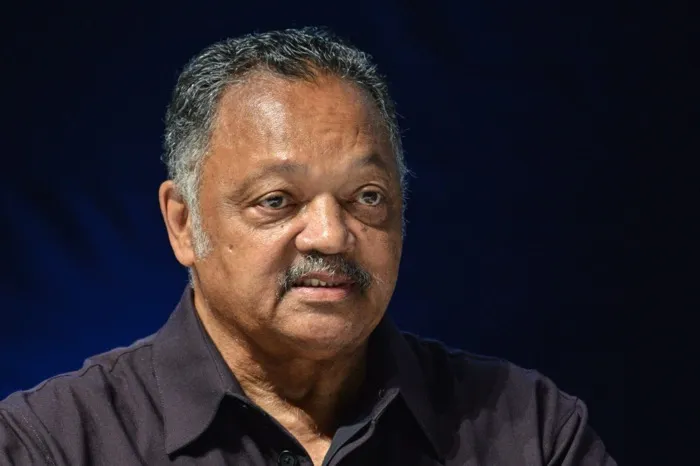
The nation is mourning the loss of Rev. Jesse Jackson, pioneering civil rights leader and two-time presidential candidate, passes away at 84. A towering figure in American history, Jackson died peacefully Tuesday morning, surrounded by his family, according to a statement released by his loved ones.
His family remembered him not only as a father and grandfather, but as a global advocate for justice.
“Our father was a servant leader — not only to our family, but to the oppressed, the voiceless, and the overlooked around the world,” the family shared. “We shared him with the world, and in return, the world became part of our extended family.”
Jackson is survived by his wife, Jacqueline, six children, and several grandchildren. His passing marks the end of an era in American civil rights leadership.
From the Jim Crow South to the National Stage
Born on October 8, 1941, in Greenville, South Carolina, Jesse Louis Jackson grew up during the height of Jim Crow segregation. Raised by his mother, Helen Burns, and later adopted by his stepfather Charles Henry Jackson, he experienced racial discrimination firsthand.
He attended segregated schools, drank from “colored” fountains, and endured taunts about his birth. But those early hardships fueled a drive that would shape his destiny.
After graduating from Sterling High School, Jackson attended the University of Illinois before transferring to North Carolina Agricultural and Technical College (A&T). It was there that his activism took root. He joined the local Congress of Racial Equality chapter and participated in sit-ins and protests challenging segregated public facilities.
In 1960, he became part of the “Greenville Eight,” a group of Black students arrested after refusing to leave a whites-only public library. Their protest ultimately helped integrate the city’s library system — one of the first of many victories in a lifetime dedicated to equality.
A Protégé of Dr. King
Jackson’s life changed profoundly when he joined forces with Martin Luther King Jr.. After witnessing the violence of Bloody Sunday in Selma in 1965, Jackson organized fellow seminary students to march alongside King.
Impressed by his energy and leadership, King offered Jackson a staff position with the Southern Christian Leadership Conference (SCLC). Jackson soon became a national voice within the movement.
In Chicago, he led Operation Breadbasket, an SCLC initiative aimed at improving economic opportunities for Black Americans. Under his leadership, the program secured thousands of jobs and millions of dollars in new income for Black communities.
Following King’s assassination in 1968, Jackson remained a visible and sometimes controversial figure in the movement. While some critics accused him of acting independently, few questioned his commitment to racial and economic justice.
Building the Rainbow Coalition
In 1971, Jackson founded Operation PUSH (People United to Serve Humanity), later merging it with the National Rainbow Coalition to form the Rainbow PUSH Coalition.
Through this platform, he expanded his focus beyond race, advocating for women, working-class Americans, and marginalized communities. He became one of the first major Democratic leaders to publicly champion LGBTQ rights and consistently pushed for expanded voting access.
For decades, the Rainbow PUSH Coalition worked to “level the economic and educational playing fields,” turning Jackson into a global ambassador for human rights.
Historic Presidential Campaigns
Jackson broke new ground in American politics when he ran for the Democratic presidential nomination in 1984 and again in 1988. At a time when few believed a Black candidate could mount a serious national campaign, Jackson exceeded expectations.
In 1984, he finished third in a competitive race. Four years later, he placed second, winning several primaries and galvanizing minority and working-class voters. His campaigns emphasized economic fairness, equal protection under the law, and broader political participation.
Although he never secured the nomination, his candidacies reshaped Democratic politics and paved the way for future generations of leaders.
Diplomat and Global Advocate
Beyond domestic politics, Jackson took on international roles. In the 1990s, he served as U.S. special envoy to Africa under President Bill Clinton. He also worked independently to negotiate the release of American hostages in countries such as Syria, Cuba, Iraq, and Kuwait.
His efforts sometimes stirred controversy but demonstrated his willingness to step into complex geopolitical conflicts to bring Americans home.
Jackson also served as Washington, D.C.’s “shadow senator,” lobbying Congress for statehood for the District. For him, democracy was never just a slogan — it was a lifelong mission.
Personal Trials and Public Resilience
Like many prominent figures, Jackson’s life was not without controversy. During the 1984 campaign, he faced backlash for offensive remarks about Jewish Americans, comments for which he later apologized. In 2001, he publicly acknowledged an extramarital affair that resulted in the birth of a daughter.
In later years, he battled Parkinson’s disease, a diagnosis he shared publicly in 2017. In 2021, he and his wife were hospitalized with COVID-19 but recovered after treatment in Chicago.
Despite health challenges, Jackson continued to speak out whenever possible, renewing calls for fairness in America’s political and economic systems.
A Lasting Legacy
Though he stepped back from the spotlight in recent years, Jackson remained a symbol of perseverance and moral conviction. His speeches — passionate, rhythmic, and deeply rooted in faith — inspired millions.
His family described him as a “tireless change agent” whose presidential campaigns, voter registration drives, and global advocacy efforts helped shape a movement for dignity and human rights.
The passing of Rev. Jesse Jackson, pioneering civil rights leader and two-time presidential candidate, passes away at 84 closes a remarkable chapter in American history.
From segregated classrooms in South Carolina to presidential campaigns and international diplomacy, his journey reflected both the struggles and the possibilities of America itself.
His life’s message was clear: democracy must be expanded, justice must be pursued, and equality must never be postponed.